
First winter behind the wheel: 8 habits for new drivers
Got your learner's or probationary licence this year and never driven in snow? Here are 8 concrete habits that make a real difference from the first snowfall, from the driveway to the highway.
Winter driving in Quebec is about more than just going slower. It is a set of small actions you repeat every time you head out: getting the car ready, checking the roads, keeping your distance, braking differently and knowing what to do when the car starts to slide. Experienced drivers do these things without thinking. This is your first winter, so it is the perfect time to build the right habits.
A quick word on tires: winter tires are mandatory from December 1 to March 15. We explain why you should not wait for that date in our article on fall driving for new drivers. This guide covers what happens once your winter tires are on.
Habit 1: clear the whole vehicle, not just a peephole
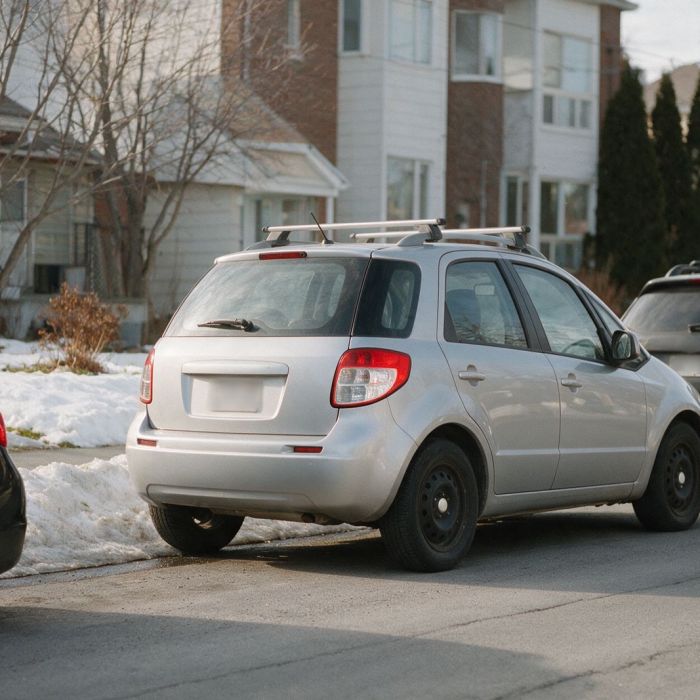
A small square scraped in the windshield is not enough. Before you leave, clear every window, the mirrors, the roof, the hood, the front and rear lights, the licence plate and the snow packed on the fenders. Snow on the roof can slide onto your windshield the first time you brake, or blow onto the car behind you.
This is not just good sense. It is also the law.
| Situation | Fine |
|---|---|
| Vehicle covered with snow or ice that could come loose | $60 to $100, plus costs |
| Visibility reduced by snow or ice on the windows | $100 to $200, plus costs |
According to Québec.ca, you will also have to clean the windows and windshield if you are stopped. Give yourself a few extra minutes in the morning: clearing a car properly takes time.
Habit 2: check Québec 511 before you leave
Before a trip, especially on the highway or outside your usual area, check Québec 511 (website or app). It shows road conditions, closures, crashes and traffic cameras. When conditions are very poor, the government recommends postponing non-essential trips. And a closed road stays closed: never try to get around it.
For a new driver, it is also an easy way to decide whether to leave earlier, take another route or wait until the plows have gone through.
Habit 3: leave a lot more space ahead
On a snowy road, you need much more distance to stop. CAA-Québec recommends aiming for at least 6 seconds behind the vehicle ahead, and more depending on conditions. To measure it, wait until the car ahead passes a pole, then count slowly. If you reach the pole before "six", back off.
That space gives you time to brake gently instead of suddenly, which is exactly what the next habit is about.
The posted limit is meant for a dry road. According to the SAAQ, driving that is not adapted to weather and road conditions carries a $60 fine, plus costs, and 2 demerit points. With a learner's or probationary licence, every point counts.
Habit 4: brake early, brake gently, and understand ABS
In winter, sudden moves are your enemy: hard braking or a quick turn of the wheel can make you lose grip. Start slowing down further ahead of stops and curves, and ease off the gas well before you get there.
If your car has anti-lock brakes (ABS), which your owner's manual will confirm, here is how to react. In an emergency stop, press the pedal firmly and keep the pressure on. Do not pump: the system does that for you. You may feel the pedal pulse and hear a clunking sound. That is normal and means ABS is working. Do not let go of the pedal in surprise, and keep steering: ABS is there precisely so you can keep control of the wheel while braking.
Habit 5: in a skid, look where you want to go
Even careful drivers skid at some point. The natural reflex is to stare at what you want to avoid, and your hands follow your eyes. You need to do the opposite.
Release the gas and the brake. The wheels need to regain grip before you can steer the car.
Keep your eyes on your lane, not on the snowbank or the pole. Your hands will follow.
If the rear slides out, turn the front wheels in the direction the rear is going. Use small corrections, never sudden ones.
The car may swing back the other way. Correct again, quickly but smoothly, until it is stable.
Habit 6: watch for black ice, especially on bridges
Black ice is a thin, clear layer of ice: the road simply looks wet. CAA-Québec points to the riskiest spots: bridges, overpasses and open areas, especially when the temperature is around 0°C. Shaded areas deserve extra attention too.
Before a bridge or overpass, ease off the gas and avoid braking or changing lanes on it.
Habit 7: give snowplows plenty of room
Snow removal vehicles are big, slow and have large blind spots. Québec.ca asks drivers to be patient around them, and the SAAQ reminds drivers to stay out of their blind spots and keep a safe distance.
- Stay behind: the road is often in better shape once they have gone by.
- Never pass snowplows travelling in close formation, and never cut in between them.
- Keep out of their blind spots, behind and on the sides.
Habit 8: see and be seen
In winter, it gets dark early and snow cuts visibility. Turn your headlights on whenever needed and do not rely only on the automatic setting: according to Québec.ca, it does not guarantee that your rear lights are on. With daytime running lights alone, your dashboard can be lit while the back of the car stays dark.
Keep your lights clean during the trip, your winter washer fluid topped up and your wipers in good shape.
The winter kit to keep in your trunk
If you get stuck in a snowbank or break down on the side of the road, a few items make all the difference. Here are the essentials recommended by Québec.ca:
- shovel, scraper and snow brush;
- traction mats and a bag of sand;
- washer fluid and fuel line antifreeze;
- flashlight and batteries, matches or a lighter, and candles;
- jumper cables or a jump starter;
- water and non-perishable food;
- warm blanket, gloves or mitts, boots, scarf and toque.
Practise with an instructor. The on-road sessions in the course take place in every season. If your course runs through the winter, you practise these habits with an instructor in real winter conditions. To see where these sessions fit in the program, read about the 4 phases of the driving course.
Frequently asked questions
Yes. A vehicle covered with snow or ice that could come loose can get you a fine of $60 to $100, plus costs. If snow or ice reduces your visibility, the fine is $100 to $200, plus costs.
CAA-Québec recommends at least 6 seconds, and more depending on conditions. That is much more than in summer: on snow or ice, you need more distance to stop.
No. Press firmly and keep the pressure on. The pedal may pulse and make noise: that means ABS is working. Keep steering while you brake.
You must not pass snowplows travelling in close formation. With a single plow, patience is still the best choice: stay behind and out of its blind spots.
Your first winter, with an instructor beside you
Vision Plus is a SAAQ-recognized driving school with 5 schools from Laval to Saint-Jérôme and on-road sessions in every season. Find the closest one on our Our schools page.
Register onlineInformation verified in October 2026. Gouvernement du Québec: Tips for safe winter driving, Snow and ice removal. CAA-Québec: Winter driving tips (in French). Rules can change: check these sources for the current version.