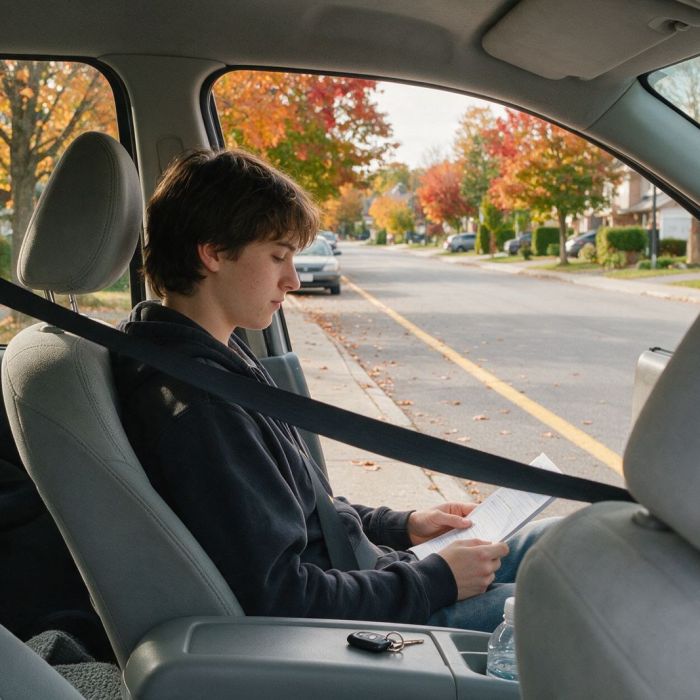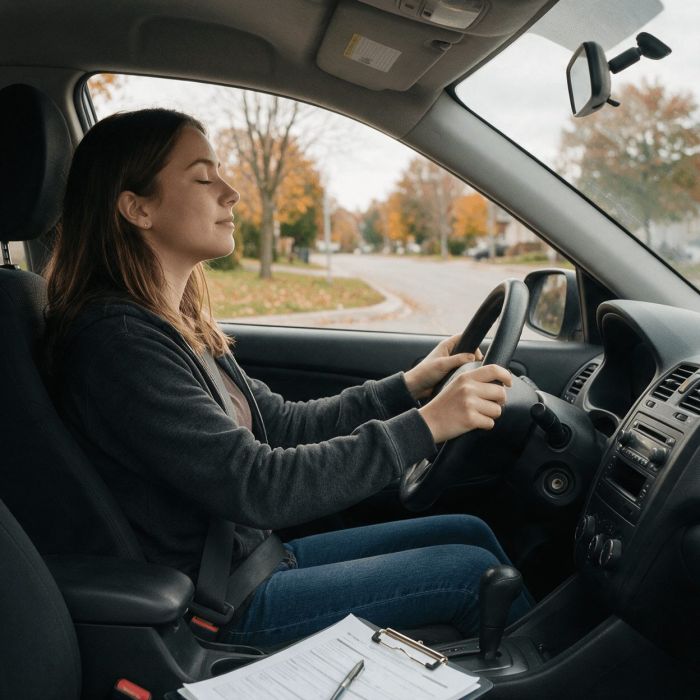

Parallel parking: step by step
Parallel parking makes a lot of new drivers nervous. With a simple reference-point method, checks done at the right moment and the legal distances in mind, it becomes just another manoeuvre.
A street lined with cars, one open spot, someone waiting behind you: that is usually when the stress kicks in. Parallel parking does not take special talent. It takes a clear sequence, repeated until it becomes automatic, and a very slow speed. Here is the method, the checks, the Highway Safety Code rules and what changes in a Quebec winter.
Before you start: pick the space and signal
First, make sure the space is big enough. As a beginner, look for a space at least 2 metres longer than your car. With practice, you will fit into tighter spots.
Also make sure you are allowed to park there (the legal distances are further down). Then check your mirror, turn on your signal on the side of the space and slow down gradually, so drivers behind you understand that you are about to stop and back up.
Manoeuvring speed. In reverse, let the car creep and control it with the brake. The slower you go, the more time you have to correct.
The 4-step reference-point method
You will find this method in the official driver handbooks of several provinces. The exact reference points vary from car to car, so fine-tune them with your instructor.
Stop parallel to the car parked ahead of the space, about 0.5 to 1 metre away from it. Line up your rear bumper with its rear bumper. Wheels straight, signal still on. Shift into reverse.
Check your mirrors and look over your shoulder. If the way is clear, back up very slowly while turning the steering wheel all the way toward the curb. Stop when your car is at roughly a 45-degree angle to the curb.
Straighten the wheels and keep backing up slowly. Watch the front of your car: it needs to clear the back of the car ahead without touching it. Your front end swings out toward the lane, so keep an eye on oncoming traffic.
Once your front bumper has cleared the car ahead, turn the wheel all the way toward the street and keep reversing until your car is parallel to the curb. Pull forward if needed, straightening the wheels, to centre yourself in the space.
If the angle is off, pull out gently and start again from step 1 rather than stacking up small corrections.
Mirror checks, shoulder checks and signals
Visual checks are what make the manoeuvre safe, especially in the city with cyclists and pedestrians around.
- Before stopping: inside mirror, then the mirror on the side of the space, and your signal.
- Before reversing: mirrors, then a look over both shoulders. A pedestrian can walk behind the car.
- While reversing: alternate between the back and the front of the car. The front sweeps into the traffic lane as you turn.
- When pulling out: signal toward the street, check your mirror, then look over your shoulder for the blind spot before you move.
A backup camera helps, but it will not show a bike coming up beside you or a car approaching in the lane.
How close to the curb, and which way to face
The Highway Safety Code is clear: a vehicle must be parked no more than 30 centimetres from the nearest curb, facing the same direction as traffic, unless the authority responsible for maintaining the road indicates otherwise (section 383 of the Highway Safety Code).
To judge 30 cm, get out and look the first few times. You will quickly learn what the right distance looks like in your right-hand mirror.
Where you cannot stop
Section 386 of the Highway Safety Code lists the places where no one may stop a road vehicle, except in case of necessity or where the Code allows it. These are the ones that come up most often when parking on the street:
| Location | Highway Safety Code rule |
|---|---|
| Fire hydrant | Not within 3 m |
| Intersection | Not in it or within 5 m |
| Marked pedestrian crosswalk or bicycle crossing | Not on it or within 5 m |
| Level (railway) crossing | Not on it or within 5 m |
| Police or fire station | Not within 5 m, or 8 m on the opposite side of the street |
| Sidewalk, median, traffic circle (roundabout) | Prohibited |
| In front of a sidewalk ramp built for people with disabilities | Prohibited |
Municipalities have their own parking bylaws, sometimes with larger distances, such as 5 m from a fire hydrant or a stop sign. Section 386 of the Code sets no specific distance for stop signs, but your city may. When in doubt, follow the posted signs and your local bylaw.
Parking on a hill
On a slope, the Code requires you to apply the emergency (parking) brake and turn the front wheels so that any movement of the front of the vehicle is toward the nearest curb. Québec.ca puts it simply: apply the parking brake and turn the front wheels toward the curb.
Make it a habit: parking brake on, shifter in P, steering wheel turned toward the curb before you switch off the engine. If the car moves, it heads for the curb instead of into traffic.
The most common mistakes
- Starting too far from or too close to the car ahead. Too far and you end up away from the curb; too close and you risk clipping it.
- Reversing too fast. You lose your reference points.
- Forgetting the front of the car. As you turn, the front sweeps into the lane. That is where fender benders happen.
- Hitting the curb. Usually a late final turn: pull forward a little and try again.
- Pulling out without a signal or a blind-spot check. A cyclist can come up fast.
Parallel parking and the SAAQ road test
According to the SAAQ, the road test evaluates independent driving, visual checks, vehicle control, confident and courteous driving, and compliance with traffic rules. The SAAQ does not publish a list of mandatory parking manoeuvres. If the examiner asks for one, remember that vehicle control and visual checks are among the things being assessed.
For overall test preparation, see our article How to pass the SAAQ road test on your first try.
Winter specifics
Snowbanks often hide the curb, which makes 30 cm hard to judge. Approach slowly, do not force your way into packed snow, and leave room in front and behind: on a slippery surface, the car slides further after you brake.
Keep seasonal rules in mind too. Québec.ca notes that a sign can indicate parking prohibitions that apply only in winter, sometimes with orange parking control lights. Many municipalities also ban overnight parking in winter or during snow removal, and these rules vary from city to city, so check your own municipality's rules. For more seasonal advice, read our guide to fall driving for new drivers.
Frequently asked questions
The Highway Safety Code requires a parked vehicle to be no more than 30 centimetres from the nearest curb, facing the direction of traffic, unless signs indicate otherwise.
The Code prohibits stopping within 3 metres of a fire hydrant. Some municipalities require more distance, so check your local bylaw.
The SAAQ does not publish a list of mandatory manoeuvres. It publishes the areas being assessed, including vehicle control. It is still wise to master the manoeuvre.
Apply the parking brake and turn the front wheels toward the curb, so that any movement of the front of the vehicle is toward the curb, as the Code requires.
Practise with an instructor
Vision Plus is a SAAQ-recognized driving school with 5 schools from Laval to Saint-Jérôme, where you practise on real roads in every season: find the school nearest you.
Register onlineInformation verified in October 2026. Highway Safety Code, sections 383 and 386: LégisQuébec. Parking a vehicle: Québec.ca. Road test: SAAQ. Rules can change: check these sources for the current version.